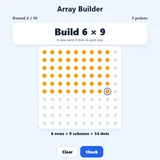
Array Builder shows what multiplication actually means. Instead of memorizing that 3 × 5 = 15, you build it: three rows with five dots in each row. Then you count the dots and see the product appear. Array Builder is the best place on the site to start if a child is new to multiplication, or if the facts feel like random numbers that refuse to stick.
How to Play Array Builder
Choose a grid size on the start screen: small (up to 6 × 6), medium (up to 10 × 10) or large (up to 12 × 12). Each game has 10 rounds, and there are two kinds of round.
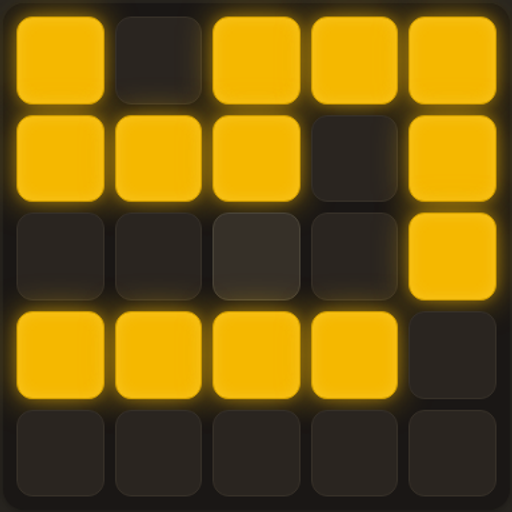
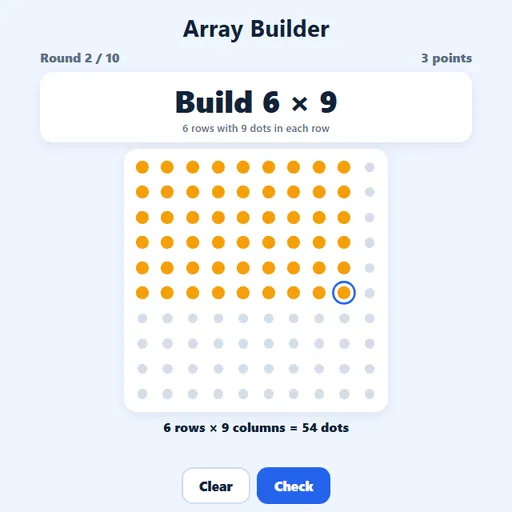
In a Build round, the game shows a fact such as Build 4 × 7. Drag from the top-left dot down and across, or simply tap the dot where your array should end. The dots inside your rectangle light up orange, and the line below the grid counts them for you: 4 rows × 7 columns = 28 dots. Press Check when it looks right.
Every third round is a Make round. The game asks for a number of dots, such as Make 24 dots, and any rectangle with at least two rows and two columns counts. After a correct answer, the game lists the other arrays that would also have worked, like 3 × 8, 4 × 6 and 6 × 4.
At the end you see your points out of 30 and up to three stars, and your best score for each grid size is saved.
Array Builder Controls
| Action | Keyboard | Mouse | Touch |
|---|---|---|---|
| Set the corner of your array | Arrow keys move the corner | Click or drag across the dots | Tap or drag across the dots |
| Check your array | Enter | Click "Check" | Tap "Check" |
| Clear the grid | Backspace or Escape | Click "Clear" | Tap "Clear" |
What Kids Learn From Arrays
- Multiplication is equal groups. Each row is one group, and every row has the same number of dots.
- Order does not change the total. Turning 3 × 8 on its side gives 8 × 3 with the same 24 dots.
- Numbers can be built in several ways. Make rounds show that 36 can be 4 × 9 or 6 × 6, an early step toward factors.
- Area makes sense later. Arrays are the same idea as the area of a rectangle in rows and columns of squares.
Tips for Parents and Teachers
Ask your child to say the fact out loud as they drag: “four rows of seven.” Then ask how they could count faster than one by one, for example by skip counting each row: 7, 14, 21, 28. When arrays feel easy, move to Times Table Practice to work on recall, or try the Times Table Grid Challenge, where every square of the chart is an array’s size. The step-by-step learning order on Multiplication.com also starts with arrays.
Tested and updated: