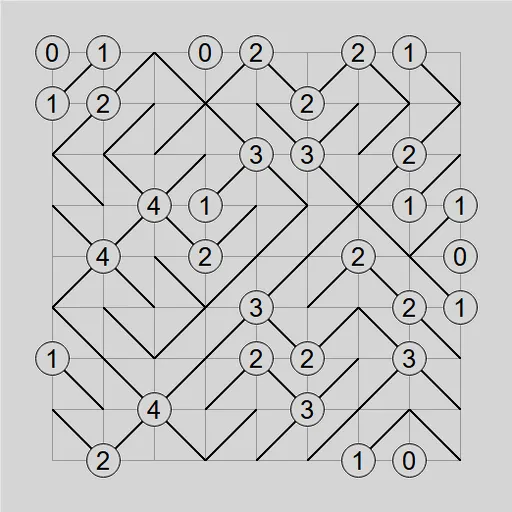
Slant Diagonals asks you to fill a grid with nothing but diagonal lines. Every square gets one line leaning left or right, and small circled numbers on the grid corners say how many lines must meet at each point. The catch is that the lines can never close into a loop. It is Slant from Simon Tatham’s Portable Puzzle Collection, a puzzle that turns two simple rules into long chains of deduction.
How to Play Slant Diagonals
Each square holds a single diagonal. A \ runs from the top-left corner to the bottom-right, and a / runs from the top-right corner to the bottom-left. Blank squares are not allowed in a finished board.
The circled clues sit on grid points. A clue counts how many of the up to four squares around that point have their line touching it. A 4 forces all four lines to point at its center, and a 1 means only one of them does.
The second rule is that your lines must never form a closed loop, however large. In a finished board, every chain of lines reaches the outer edge. The game shows lines that close a loop and clues that can no longer be met in a warning color, so you can spot trouble fast.
Left-click a square to place a \ and right-click to place a /. Clicking again cycles through both lines and back to empty. The board flashes once it is solved. Presets offer 5x5, 8x8 and 12x10 grids at Easy or Hard, and Hard puzzles need you to reason about how pairs of squares relate.
Slant Diagonals Controls
| Action | Keyboard | Mouse | Touch |
|---|---|---|---|
| Place or cycle a \ line | Arrow keys to move, then Enter | Left-click a square | Tap a square with Tap set to "\ first" |
| Place or cycle a / line | Space | Right-click a square | Press and hold, or set Tap to "/ first" and tap |
| Set a square to one direction directly / empty it | Type / or \ / Backspace | — | — |
| New game, undo, redo | N, U, R | Menu buttons above the grid | Menu buttons above the grid |
Tips and Strategies
- Settle the 0s and 4s first. They decide every square around them.
- A clue on the border touches only two squares, so a 0 or a 2 there fixes both lines. A clue on a corner of the grid touches just one square.
- After each line, check the clues at both of its ends. One new line often completes a clue, which then pushes its other squares to slant away.
- Watch for three sides of a small diamond. The fourth square has to lean the other way to avoid a loop.
- When a clue already has as many lines as its number, every remaining square around it slants away from it.
- If you prefer, Preferences lets you swap which mouse button places which slant.
Features
- Six presets in three sizes and two difficulty levels, plus custom grids
- Instant warnings for loops and for clues that cannot be satisfied
- Full keyboard play, including direct / and \ keys
- Unlimited undo and redo, Solve, and touch support with a tap switch
Tested and updated: