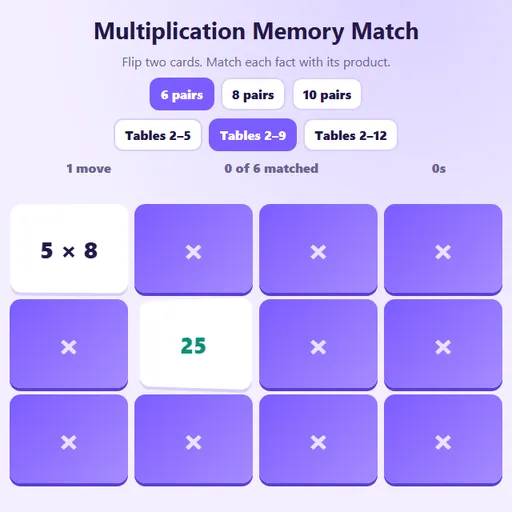
Multiplication Memory Match mixes a classic concentration card game with times table facts. All the cards start face down. Half of them show a fact, like 7 × 3, and the other half show a product, like 21. Turn over two at a time and try to pair each fact with its answer. Multiplication Memory Match works two skills at once: remembering where cards are, and knowing which product belongs to which fact.
How to Play Multiplication Memory Match
Pick a board size first: 6, 8 or 10 pairs. Then choose a table range: 2 to 5, 2 to 9, or 2 to 12. A new board is dealt every time you change a setting.
Click or tap a card to flip it. Fact cards show the multiplication in dark text, and product cards show the answer in green, so you can always tell which kind you have turned over. Then flip a second card. If the product matches the fact, both cards stay face up and turn mint green. If they do not match, both flip back after a short pause.
The counters above the board show your moves, the pairs you have matched, and the time since your first flip. Match every pair to see your result. The game saves your best score for each board, ranked by fewest moves and then fastest time.
Multiplication Memory Match Controls
| Action | Keyboard | Mouse | Touch |
|---|---|---|---|
| Flip a card | Tab to a card, then Enter or Space | Click a card | Tap a card |
| Change the board | — | Click 6, 8 or 10 pairs and a table range | Tap 6, 8 or 10 pairs and a table range |
| Deal a new board after a win | Enter | Click "New board" | Tap "New board" |
Strategy Tips
- Solve before you flip. When you turn over a fact card, work out the product first. Then you know exactly which number you are looking for.
- Sweep the board in rows. Early on, flip unknown cards in order so your memory map stays tidy.
- Say the fact out loud. Saying “six times eight is forty-eight” helps you remember both the card’s spot and the fact.
- Grow the board slowly. Move from 6 to 8 pairs before you widen the table range.
Why Matching Helps Times Tables Stick
Seeing a fact and its product side by side, over and over, builds a direct link between them. Over time the product comes to mind without any counting. Matching also works in reverse, from 42 back to 6 × 7, which is the same thinking used in division and in finding factors. When matching feels easy, try filling a Times Table Grid Challenge, or browse the times tables from 1 to 12 on Multiplication.com.
Features
- Three board sizes and three table ranges, with a saved best for each mix.
- Unique products on every board, so each card has one true partner.
- Keyboard support, with cards that can be reached and flipped with Tab and Enter.
Tested and updated: