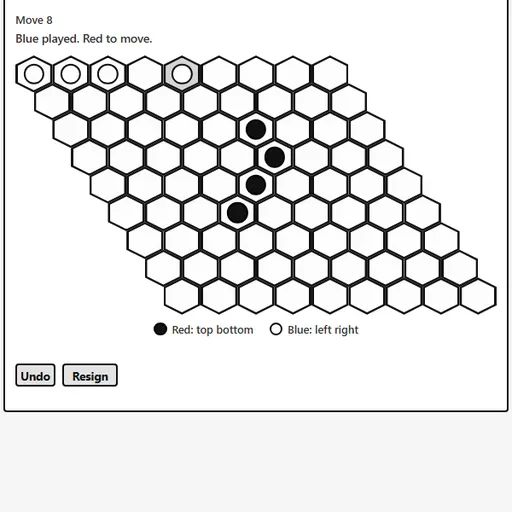
Hex is a connection game with only one rule for moving: place a stone on an empty cell. The board is a 9x9 diamond of hexagons, and each player owns two opposite edges. The first player to link their own edges with an unbroken chain wins. This Hex version belongs to Christopher Müller’s open-source PaperGames collection. You can face a computer opponent with three levels or play a friend on the same screen. The game looks simple, but blocking and connecting turn out to be the same thing.
How to Play Hex
Red always moves first, then the players take turns. Each turn you put one stone of your color on any empty hexagon. Stones are never captured and never move.
Red tries to build a path of touching red stones from the top edge to the bottom edge. Blue tries to do the same from the left edge to the right edge. Each hexagon touches six neighbors, so a chain can bend in many directions. The moment a complete path exists, the game announces the winner.
Because the two goals cross each other, there is no way for both players to fail. Every stone you add either helps your own chain or gets in the way of the other one, and usually both.
Against the computer you pick your color and a level. Easy plays random cells. Medium measures how many stones each side still needs to connect and chooses among its best options. Hard searches a few moves ahead over the most promising cells.
Hex Controls
| Action | Keyboard | Mouse | Touch |
|---|---|---|---|
| Place a stone | Tab to the board, arrow keys to pick a cell, Enter to place | Click an empty hexagon | Tap an empty hexagon |
| Choose color and opponent | — | Pick Red or Blue and a level, then click "New game" | Pick Red or Blue and a level, then tap "New game" |
| Take back a move | — | Click "Undo" | Tap "Undo" |
| Give up | — | Click "Resign" | Tap "Resign" |
Tips and Strategies
- Start near the center. A central stone can head toward either of your edges and is hard to cut off.
- Use the bridge. Two of your stones with two shared empty neighbors between them cannot be separated. If the opponent takes one gap, fill the other.
- Block from a distance. A stone placed right next to an enemy chain is easy to walk around. Block two or three rows ahead instead.
- Do not race along an edge too early. Stones on the edge help less than stones that threaten several paths at once.
- Watch the acute corners. The two sharp corners of the diamond are where short connections often get settled late in the game.
Features
- A 9x9 hexagon board with a color legend for both players
- Computer opponent with three levels, plus a two-player mode
- Choose to play Red or Blue
- Undo and Resign buttons, and automatic saving of the game in progress
- Settings for text size, contrast, spacing and computer speed
Tested and updated: